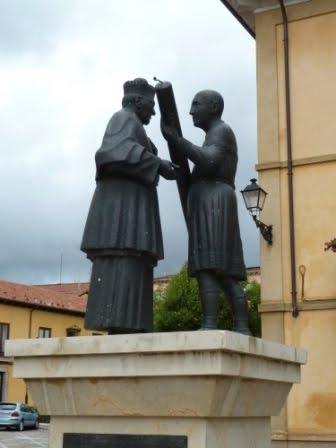
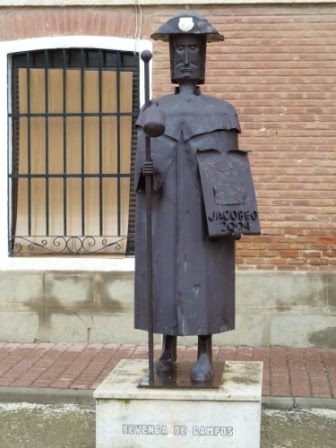
Today I will really keep it short. I am sitting in a bar with free WiFi opposite the albergue (in the Benedictine Sisters' convent) in Leon, with a red wine in front of me. Today's ride was cold and wet, as predicted, but not as wet and certainly not as wet as yesterday. I made it here in three and a half hours of riding, so by 11.00am, which reflects the better conditions - it was flat too. The albergue is fine, if a little basic, and provides breakfast tomorrow, which is a bonus. Funnily enough, I saw barely any pilgrims on the road today - just six on foot, and no cyclists at all - and some of the people I was with yesterday, including Glenn and Fr. Thom, arrived here by bus. That tells you what yesterday was like! The Puerto-Rican lady from Fromista turned up by bus too, but that's because her toe nail fell off yesterday, as it was threatening to do. Maybe I will finally find out her name. Anyway, some pilgrims have arrived by foot or bike, but not all...
Leon is an interesting city. I have warmed to it in some ways, and not in others. The signs took me a very round-about way to get to the cathedral, and finally abandoned me to find my own way. It was worth the effort. It was one of those times when you walk into a building and your mouth falls open. There was something about the awesomeness of the space, but also there was the stained glass. For the first time in Spain, the stained glass left me gasping. I had to walk around twice, enjoying it all, and I took it at an abstract colour and light level. To take in the details would have needed much, much longer. In fact, though, my eight favourite windows were abstract in design, and intensely colourful. You can find photos of them all in the photostream at the left. There were other wonderful details too - shadows of wrought ironwork, a wonderful lock on a door, a beautiful chapel where the font is situated, a carved screen. Nothing seemed to intrude, and the space was wonderfully uncluttered compared to a lot of the Spanish churches, I am afraid.
The exterior is much more conventional, but there were interesting details, especially the one-handed clock, and I was glad to be there when 12.00 struck. All sorts of different peals seemed to happen, and I wouldn't have missed it for anything. I was quite surprised to realise I had spent an hour in there. It took the next half hour and four sets of instructions to find the Tourist Office, and none of those instructions really helped! However the person in the office was wonderfully helpful in every way, and I was soon at the albergue. The welcome there was extremely efficient and warm, and I am sure it will do the trick. There has been more rain since getting there, but I haven't got my evening clothes wet, you will be pleased to hear, and it hasn't rained for a couple of hours really now. Let's hope that is a good sign for tomorrow.
Glenn has helped me 'true' my back wheel, which hasn't been right since the last spoke replacement I did in France, and had been getting worse. He is an enthusiastic rider of recumbent bikes, and even a velo-bike, and does all his own maintenance, so I was glad he had turned up here. I didnt' feel confident doing the job alone, and couldn't find the energy to locate a bike shop, though there is one somewhere, apparently. Anyway, that's a relief to have done before the next few days which will get steadily more demanding and see me through the hardest bits. Tomorrow I will do another full clean up of chain and gears when the rain is hopefully over. Today's vital job was to get all the grit and sand off the bike and panniers before taking them into a clean dormitory!
I have spent some more time wandering round Leon this afternoon and caught some interesting photos, but I will let you explore those yourself rather than commenting endlessly. What they don't show is the mixture of lovely, historical charm and scruffy, defaced buildings. This truly is a city of contradictions, much more cramped and convoluted than, say, Burgos.
This evening there is a service of vespers at 7.00pm, followed by mass at 7.30pm, which is going to be said by my friend Fr. Thom. Before that, a group of us are going to head out to Burger King for a fix of familiar food, and then it will be time to settle down before the pilgrim blessing at 9.30pm and lights out at 10.30.
Bye for now.
This blog began in as the story of a sabbatical journey by bicycle from home in the north of England to Santiago de Compostela in north-west Spain. I reckon it is time to pick up the journey in a different way...
Friday, 11 June 2010
Thursday, 10 June 2010
Where in the world is David today? Sahagun
OK, so here are today's catch up items. First, I got bitten badly in the night a couple of nights ago (in Burgos, in fact) and the irritation is only just going. Second, I have been noticing more and more just how many churches there are - you can often see at least five or six from wherever you are - two or three in one town, sometimes. What that has left me wondering about is what that says about the presence of God everywhere. I know, I know, I am supposed to understand that this is why we have a parish system in the Church of England, but it has come across to me very strongly here. In particular, it has me reflecting on what the reverse would say - i.e. we all gather at the places where the life is. Local here is local, and there is something very significant about that. It isn't all that difficult to get from Village A to Village B in the Tees Valley - here it may be a really stiff walk or an uncomfortable drive, and not an easy cycle, I should add. That deserves some more thought.
The third thing I have noticed, though I may be wrong, is that perhaps the age profile of the pilgrims I am meeting is changing slightly - upwards. I seem to be meeting less college students doing the Camino after exams and taking a rush at it, and more 'older' pilgrims taking the Camino at its own pace, perhaps for the second or third time. Maybe that is why the crowd in last night's refugio/albergue (which was very full) were such quiet and considerate people. Or maybe it is simply to do with tiredness setting in, or any number of other things. At any rate, they were considerate and quiet, even though they were just as keen to get on the move this morning. As ever, I was sorry to say goodbye and 'Buen Camino' to the people I had chatted with - John, the Verger of St George's Hanover Square, and the lady from Puerto Rico, whose name I never learned to mention just two.
We woke up to torrential rain this morning, as expected, but it stopped at breakfast time. I hoped, in vain, that it would turn out to be a weather system having blown through, but I was wrong, so wrong (hence there are almost no pictures at all today). I put on partial wet weather gear anyway, and hoped for the best, and it seemed OK for the first 8km or so. The wind was still strong, but the rain was just 'spitting'. But that didn't last, and by the first time the road kinked (from WNW to WSW) it was wild, and that turn was a turn from a cross wind to a vicious cross wind. So today's word is wild. You just have to look at the ride statistics to get a sense of it. There is a section that was entirely level where my average speed dropped to about 8mph, and I really wondered whether I could keep going.
Remember I wrote yesterday about just keeping the wheels turning? I had to keep reminding myself. Psychologically, today has actually been the toughest day (in reality rather than in anticipation). The thing is, you just don't get to choose your weather. Had it not been for the simple joy of spotting another creature - this time a caterpillar - crossing the road, and meeting a lovely French couple cowering in the lee of a house just when I needed to stop for a snack, I think I might seriously have had to take shelter for an hour or two and take another shot at the rest of the journey.
I'm not alone in the feeling, clearly. There were long stretches where the footpath was right alongside the road and there were no pilgrims in sight at all. The ones I did come upon were often huddled under their raincapes looking for all the world like hunchbacks. Lots of pilgrims are reporting having done a very short day today (and yesterday too, in many cases). This is a telling point in the journey, and the weather forecast is pretty gloomy for the next couple of days. There is a high pressure area lurking over the Bay of Biscay sending a series of weather systems across northern Spain, and together with the altitude factors that's dumping a lot of rain. In case you haven't seen, further north in Asturias and Galicia there has been massive flooding, washing away cars, etc. We haven't got that, but what we have is enough to soak me to the bone, the proofing having washed off my jacket after a few launderings on the way south through England and France. You should have seen the sodden skin on my palms on arrival today!
Anyway, thinking about myself, tomorrow's forecast for the Leon area (where I am headed next) is "Occasional rain and drizzle in the morning; otherwise, remaining cloudy and cool", and the forecast for the Saturday, when I head on to Astorga is "Mostly cloudy with a couple of thundershowers". Sunday through to Wednesday could be much better, but the whole journey could still end with rain. We'll see. On the other hand, thinking about others, I find myself looking back to the life of pilgrims of the middle ages, travelling in much less suitable clothing than me. I've read enough mediaeval mystery stories with passages about monks struggling through horrible weather in strange places in sodden woolen habits, but I have never quite related to them in this way before. You never catch one of them thinking or saying "I wish I had re-treated my second-best habit with Nikwax/Graingers/(substitute your own favourite proofing product) before leaving Canterbury".
One of the ironies of today was that I had chosen a specific prayer intention, thinking that it would be a good day for finding a rhythm and praying as I went. Ha, ha. It didn't exactly work as I had expected, but even then I was pleased to discover that I could adapt the pattern and stick to my intention. My bike computer beeps and starts a new lap every five miles (8.05km), so every time that happened, I consciously brought the main topic to mind again and prayed about a new aspect for a few minutes (usually till I found I could think of nothing but pedalling once again). Then I sort of 'signed off', committed the topic, and got back to what I now think of as 'the fight'. I would find it coming back from time to time, but I didn't pressure myself to work hard at it, I just kept the wheels turning as well as I could and let it turn over at a different level in the brain. By the time of the next beep, I was usually quite happy to let go of that particular aspect, and ready primed with a new one to start on. That, if nothing else, was a gift from the day.
By the time I came to the last few km, as the graphs relate, I had found a second wind and came into town quite briskly, but I was certainly ready to stop. I had read my unreliable book and knew where to head at Sahagun when I arrived, but there were several signs for a variety of albergues (refugios). One of them was for a 'new', private albergue with food available, English spoken, free WiFi and only 200m away. The decision was made, but it is a crazy place! The picture doesn't really tell the whole story. The decor is interesting - somewhere between interior of a barn and a venue for pseudo-mediaeval banquets. There are interesting bits of art all over the place, but when you find out that the artist is actually the person doing the handyman jobs around the place, you begin to understand and have more respect. In the dining room (which served an excellent three-course pilgrim's lunch, with coffee and a bottle of reasonable red wine between two for €10), is a mural of the entire family that runs the place. Slightly in the 'Olivio/Dolmio-packaging' school of art, but very well executed, and a symbol of the pride they take in the place. What was quite good, however, was a set of four figures outside, which I photographed (they are all included in this post) portraying aspects of the Camino - the Camino of Wisdom, the Mystical Camino, the Interior Camino and the Fraternal Camino. I am discovering elements of all four, with other aspects too - and definitely a physical Camino.
There are more wonderful people here (again it is very full), though I haven't come across any 'old friends' yet. Lunch was a very friendly affair, some of the people having travelled together quite a bit. I ate lunch with my German bunk-neighbour, Gregory, and next to some other people he had walked with on and off. Among them were my first two fellow bloggers, Fr. Thom Blondin and Glenn Pitre, from St John Vianney RC church in Windsor, Ontario. If you're interested, take a look at their blog on the parish website. Some of their reflections connect with mine, others (and their photographs) reflect the fact of being on foot rather than on a bicycle. Everyone makes their own Camino, even though they may intersect and sometimes overlap.
At this moment it isn't actually raining, but having got warm and dry, Sahagun can wait for another day (or another Camino). The famous guide says you could spend a whole day on its various interesting monuments, but I am happy to wind up this blog, have a kip and see what the rest of the day in the albergue brings. It is still very wet underfoot, so the minimum I would get would be soaking feet, and I'd rather not do that. So, here's signing off for another day. Perhaps I will be able to find a good connection in a city like Leon and treat you to an update on tomorrow's weather when I get there. And perhaps my clothes will be getting dry by the time I get back into the dormitory - or not, as the case may be...
Wednesday, 9 June 2010
Where in the world is David today? Fromista
Well, I shall get started on this, text only and perhaps wander down to the cafe with WiFi (two doors down) in a short while to add pictures and upload the photostream and ride data.
While I remember, I'll do another catch up, though I know there is something I have forgotten to add to my mental list. The first is a really old one - just to say that it was interesting riding through Basque country to see ETA slogans in a lot of places, but I was very struck when I saw a very forcible piece of anti-ETA graffiti in Cirauqui on the way to Estella at the weekend, and I thought I should put that on record. A second thing to mention is the ingenuity of pilgrims in overcoming their limitations. There are pilgrims of all ages, and some of the oldest I have seen were making good progress, in a little group - two with their baggage loaded in baby strollers, and one with something looking like a small wheelie bin with two sticks for handles to steer it. I wish I had a photo of that, but I think it would have looked rude! What courage and fortitude they have. I feel quite humbled.
The third thing to comment on is the sheer quantity of pilgrims. Although I knew in my head how many there were likely to be, I had been quite unprepared for what it would be like in reality. If they all had a little light on their heads and you could photograph them from space, you could pick out the entire route! They travel alone, they travel in ad-hoc groups, they travel in couples, they travel as groups of friends. And there are lots. Tonight the refugio is absolutely packed, but maybe that is partly to do with the fact that Fromista is one of the most famous of the villages on the route.
Today was expected to be wet, but seemed to start out dry. However, by the time I had climbed up to over 1000m again there was precipitation even if you couldn't call it rain, and it really inhibited the taking of pictures. It was certainly enough to justify putting on wet weather clothing for the rest of the ride as it was wet on and off for the rest of the way, and although there has been blue sky and sun for a while this afternoon, the Meseta is living up to its reputation for changeable weather and we have had a thunderstorm as well. It was also supposed to be relatively flat, but there have been several steepish climbs because this isn't exactly a dead-flat plateau at 1020m, it is cut by numerous valleys, which take you back down hundreds of feet only to have to work your back up again. It is a fascinating landscape, and two things the book got right are that there are lots of beautiful wild flowers, and the villages largely look deserted.
The trip took just about 4 hours of riding, so I was here by about 11.30am. The only three things of real note I had seen on the way were a wonderful bridge at Itero del Castillo, a Rollo (a pillory) at Boadillo del Camino, where the church - said to have some notable features - was shut, and an apparently disused ladder of canal locks with no gates and a cascade of water. (Boadillo was also plagued with Camino tourists - wearing the right shoes and gear, but actually doing their sightseeing by coach. Grrr.) I didn't realise the significance of the canal at the time, but I researched it just now and discovered that it is part of the Canal de Castilla. For a briefer description, try this link, but I think it is worth reading the whole essay. It is either a tribute to the amazing (human) spirit of the Age of Enlightenment, or a monument to folly, or both. Take your pick, but read one of the links, don't just take my word for it.
As it was only a short distance from Fromista I pressed on. I should say that I had been riding on and off since Castrojeriz with a French couple who had come from Rouen, also on road bikes, but with far less luggage. They were obviously seasoned riders, and very strong ones, but it told me something about my improved fitness that I not only kept up, in the end I left them behind when I couldn't resist covering the last few miles to Fromista at speed. I should be careful - there have been a couple of knee twinges today. I must say, however, to ride together for a while is a good thing, especially with other people who just like to set a good rhythm and stick to it. That's the way to get there - find a rhythm and just keep the wheels turning, and the destination will come to meet you.
Fromista's Romanesque masterpiece of a church - San Martin - certainly lives up to its reputation for simplicity and homogeneity of style. (Sorry the link page is in Spanish, but it is the best, and you will just have to use Google Translate on it.) It is an absolute gem, now that it has been restored from a) the many thoughtless additions, and b) the state of decay it had got into. There is still restoration work going on, so there was scaffolding inside, but there is so much to look at. Beautiful, simple shapes. Fascinating capitals - I wish I had the patience to read a full explanation of them in Spanish. Curious juxtapositions of rooflines. And standing clear in a good space where you can stand back and admire it - not crowded in like the cathedral in Burgos. As one photo in the photostream will show, I can even see the church beautifully from the window next to my bed (I was one of the first, so I did get to pick). A view like that is priceless - see picture at right. For all the capitals, rooflines, etc. go to the photostream at left. (By the way, the San Martin in question at this church is St Martin of Tours, taking me back to an earlier point in the journey.)
The other churches of Fromista have their own attractions, but none can compare with San Martin. What they all have in common, with each other and with every other church in the area, it would seem, is storks. I can't help photographing all the storks I see - a bit like my French pulpit collection! What is equally memorable is their sound, and to see them in flight is something else. It doesn't happen all that often - they seem quite happy sitting up there on the roof/chimney/whatever - but when they do it is a beautiful thing. So far it has always taken me by surprise with my camera stowed, so I haven't caught it, but I will keep trying.
Fromista itself, however, is a disappointing little town. Being a bit of a tourist destination, it has a number of hotels as well as the Albergues (Refugios), and lots of bars and restaurants. Otherwise, it feels dead and decaying. There are three tiny supermarkets (smaller than a corner shop) with very limited goods, and the 'big' supermarket (still smaller than most Sainsbury Local stores) has closed down. Another pilgrim - a lovely lady from Puerto Rico doing the Camino for the second time commented along the same lines. Where is all the activity?? There is road building going on everywhere, and new railways are being built all over, but where is the economic output coming from??? No wonder Spain too is looking at an austerity package. Maybe that is what the demo was about when I was in Logrono, come to think of it.
I have just noticed that the noise levels have dropped dramatically. Either a lot of people have gone out (possible), or to bed (relatively unlikely), or like those of us in the dining room at the moment they are journalling, planning tomorrow's route, texting or writing postcards. I think I am the only one writing a blog, and even I am going to stop for now. There is only so much you can read! I have had a nap this afternoon, but hopefully will still sleep well tonight (till 6.00am breakfast). I have done my route planning and folded the map appropriately. I have done and dried my laundry. I have cleaned and oiled the bike. I have shopped for provisions. Hopefully I am all set for tomorrow, and another very reasonable day across the Meseta to Sahagun. Today has overall been quite easy and restful really, and another day like it (or even more so) tomorrow would be good. The miles and the days continue to tick away.
Tuesday, 8 June 2010
Where in the world is David today? Burgos (continued) with memories of Estella
Well, I did go for a walk, and I did take a stack more pictures, and I didn't have a siesta. It did rain, but not enough to put me off wandering round, though I kept the camera covered when not needed! What a fascinating city. I continue to warm to it (apart from the cathedral, as you probably gathered, though even that is an important 'presence' in the place). It is lively, whereas Pamplona was just plain noisy, and there is a much more cultured feeling about the place. That's obviously the snob in me coming out. I hope the pictures give you a sense of the place, and I've included a couple of samples here.
One of the things I enjoyed was the series of sculptures of figures arranged around the city - the pilgrim, an old couple, a man and his son in traditional dress, a blacksmith, a girl with an umbrella (actually made into a fountain) - those are just the ones I found, and I feel sure there are more. Another pleasure was the variety of architecture, and particularly the tall windows, galleries and balconies on the houses. The Casa del Cordon was particularly interesting, as I couldn't quite work out what the sign on it meant but I could tell it was significant. The web page I've linked gives the best information I could find in English, explaining the name and the symbolism of the cordon (the 'cord' over the door), the history of the house, and the connection to Christopher Columbus. The clocks I found were a nice curiosity too.
Anyway, in the title of the post, I mentioned memories of Estella. I realised today that I finished the post from Estella two days ago (made in the afternoon) by saying that I didn't know how I was going to feed myself. In the end, I discovered that a local restaurant with a 'menu de pellegrinos' was actually open on a Sunday evening, and I decided to go down there. Most other people were eating in, but a German gentleman - Herbert Schlierf - was looking to go out too, so we went together. We could not have had a nicer evening. There are 22 years between us, but we found a great deal in common. Herbert had spent time in California in the very early 1960s while still a law student, and it was interesting to hear him reflect on that experience - so soon after the end of the war (much sooner after the end of the war than we are now to the fall of the Berlin Wall). He and his wife met through singing (at the ages of 10 and 11), just as Kate and I were connected through the oboe, and his whole family are musical - several of his five children being freelance professionals.
We enjoyed a lovely meal, and a bottle of local wine, and talked and talked. That has been the spirit of this trip. Dragging ourselves back up the hill to the refugio was not easy. With luck I may see him again at some point as he is not attempting to do the whole thing on foot at the age of 74. This is his third time on the Camino, and so he is not concerned to 'keep the rules' and get his Compostela at the end. He wanted to do a different initial section (from Somport rather than St Jean-Pied-de-Port), and at times he will use buses, so he may well catch me up or even overtake me. If not, then we have exchanged email addresses. Buen Camino, Herbert.
Something I have been reflecting on quite seriously is the relative lack of commercialism surrounding the Camino. Of course there is some - shops selling sticks and gourds and shells and statues of St Jacques and so on. However, generally speaking it has been pretty low key. Alongside that goes the straightforward generosity of spirit people show towards pilgrims, as if we are doing the pilgrimage on behalf of them all. Perhaps we are? People wave and call out to you. Restaurants offer their special discount (and very good value) menus. Museums and attractions offer discounts. People do acts of kindness for nothing. And the refugios are clearly a gift of the community in so many ways. They are frequently in properties owned by parishes or communities, and they are staffed by volunteers, who generally go beyond the call of duty to help, especially if you are simply struggling to understand. And they are cheap. The smart one in Pamplona was a princely €6, and today's was just $4. Others simply ask for a donation. They cannot possibly break even, and although it may have been more difficult yesterday, overwhelming gratitude is the only appropriate (and natural response).
That's enough for a second dose today! Sleep well, and I hope you like my picture of a priest wondering whether to step out onto the crossing. It isn't me, but I relate to him.
Where in the world is David today? Burgos
Santo Domingo trivia: because of his work providing bridges and improving the way for pilgrims, Santo Domingo is the patron saint of civil engineers, but also, according to the cathedral, of gerontologists and various other things. I failed to say yesterday that I learned a lesson about choosing a refuge: don't necessarily go for the first one you see, even if it looks charming from the outside, is run by what seems like a worthy organisation (e.g. a convent) and even perhaps looks like the 'official' one. Last night's was the nadir of refuges so far: cramped, uncomfortable, dirty, lacking in facilities, unfriendly, and even smelly in parts. When I went out walking in the city I quickly discovered that there was a comfortable, modern, well-equipped one just a few doors down the street. At any rate, if last night's was the bottom of the pile, today's is the Ritz-Carlton of refugios - a newly opened, clean, comfortable and magnificent modern refugio in a historic building. Hoorah.
Today's ride looked like it was going to develop into another hot one at first, but the heat didn't materialise. It was cool setting off at 7.00am, and there weren't too many trucks on the road at that time. I was delighted to make my first sighting of storks nesting on the tops of buildings as I exited Sto Domingo de la Calzada - they were on top of the old walls. I hadn't planned to stop so soon, but I couldn't miss catching them on film. From there it was a very straightforward journey really - N120 all the way - but the road got busier and busier as time went on with a lot of trucks. The motorway upgrade hasn't reached this far yet, but will probably mess up the best cycle routes when it does arrive. The pull uphill to Puerto de la Pedraja was tough, and it took me to 3875ft, which is actually higher than the pass by which I came over the Pyrenees, but there wasn't as much other climbing as on the previous couple of days, so the ride wasn't as long or as exhausting. That's good! There is more to come, but I am building up confidence in my ability just to keep the wheels turning. More food for thought there, I must say!
I have to say that with all the traffic, I didn't take as much notice of the scenery today, though I did glimpse some good views at bad moments for stopping on a busy road. Just after the summit there was a small, semi-open pilgrim chapel that didn't look as though it would be in use. Even so, there was confetti all over the ground, so maybe a couple came there for photos even if they weren't married in the chapel. On the other side of the road was a nice picnic place (which I didn't take a picture of) where all the benches and tables were made from old milestones - sorry, I can't get my head round calling them kilometre stones! What an interesting way of recycling them. Proper stones, that is, not lumps of concrete.
What was supposed to happen next was a long, swooping, fast downhill run into Burgos according to the book. Well, I will forgive the book this time because they author couldn't know that there would be a strong headwind today. However, even without a headwind it wouldn't have been a patch on one or two of the other descents since crossing the Pyrenees, and he seemed to think this was the best since the beginning of the journey. His judgments seem to me to be more and more subjective - negative if he was feeling tired or too hot, positive if he was fresh. The thing is, am I any better?? That's given me something to think about. When it comes to gradients, I think I am definitely more objective - I can read off the incline and the distance from the wonderfully restored bike computer and know that he underestimated the final ascent today by more than a km, and then conveniently forgot to mention that it was a double summit with another km to go beyond that even. Some of the German foot-pilgrims seem to have a book with much more detailed and helpful route profiles.
Anyway, back to the headwind. I don't know what it was, but it was enough to ensure that I needed to pedal reasonably hard in a mid-range gear to keep a constant speed on a 3% downward hill. With that much assistance from the gradient, I should have been wearing out the brakes not my legs, but if I hadn't been pedalling I would have ground to a halt. Add in the 'truck effect' and from time to time it felt like being blown backwards. So, the whole of the remaining 31km was work, not just coasting. When it came to the outskirts of Burgos, it was just like any other city in many ways, but I suddenly realised that, as with Pamplona, Logrono and Sto Domingo, the approach into the city was flat - in complete contrast to most of the major French cathedral cities where everything would turn out to be perched on top of a hill with steep approaches, even if the surrounding area had been flat. I wonder if there really is a very different pattern ?
As I got towards the centre, Burgos took on a character of its own, and I found I liked it very much. Distinctively different architecture, differently trimmed trees (in fact different species of trees), and just a different feel. Burgos is the financial capital of Spain, so there are bank-related buildings everywhere, but there is much more to it than that, and it still has an ancient feel to it. The approach to the city centre suddenly took me off over one old bridge (the Puente de San Pablo) and then back over another (the Puente de Santa Maria) to enter by a very striking gate which brought me right into the square outside the cathedral (Plaza del Rey San Fernando. And what an edifice Burgos Cathedral is - immense, and flamboyantly gothic in a very French way on the outside (it drew inspiration from the Northern French cathedrals), but with some moorish touches (pinnacles around the cloister, for example).
It turned out to be another place where you needed to pay €2.50 even as a pilgrim, and there wasn't any of the feel of being in a living church. In effect, a sign said - "If you want to pray or worship, go to a different church". I wasn't comfortable in there in the way I often have been, even in some of the extravagantly decorated Spanish churches, but I realised that it was basically a historical and cultural document in stone, and when I looked at it in that way it felt much better. Even so, I am curious that my reaction meant I was more interested in photographing floors and ceilings than the bits in between. There were few details to draw me in like the stonework of Sto Domingo de la Calzada, and I found I walked round really quite quickly, passing by many of the chapels with little more than a glance. On another occasion, in tourist mode, I might be more interested, but it didn't capture me and make me lose track of time as some places have, and I wasn't disappointed when the battery went dead in my camera (I took the last few with my phone). That was sad.
Out of the cathedral, I wasn't sure what to do next - my book didn't tell me where the tourist office was, or whether there was a pilgrim office, and the city map taped to the desk in the Cathedral shop wasn't much help. Having unlocked the bicycle, I was all set to wander into what I thought was more like the centre of town when I first got distracted by a sculpture of a weary pilgrim on a bench in the square (I came back to photograph it later) and then turned around and saw that the tourist office was right behind me all the time - a tiny door among some shops. What's more it was open, efficient and helpful. They showed me the best way to get to my magnificent refugio, and they also told me where to find this cafe with its free WiFi! Bless them.
Tomorrow's ride is slightly longer, but should be easier unless the wind blows wildly or the rain decides to pour (only the possibility of light rain is predicted). That will take me to Fromista which has a fascinating church, and if I get off early I should be there by lunchtime again. Just out of interest, it seems like I am more than a third through the miles I will do in Spain and 83% of the way there, and I am about to stow the first of my three Spanish maps and move onto the second one with ten days to go. And, by the way, my knee is doing very well, no other injuries or pains have developed (the bottom is much better with the shorter distances) and there have been no mechanical problems for several days now (which probably means I should do some maintenance tomorrow afternoon when I will have slightly more time for it. It is highly unlikely I will have a good internet connection tomorrow, so it may be another text-only update for the time being.
So that's it for now - I am going to post these rather shallow ramblings, go for a walk, and head back to enjoy a bit of siesta time on my lovely (top) bunk bed. There may be more pictures added later, but probably no more ramblings unless something remarkable happens.
Monday, 7 June 2010
Where in the world is David today? Santo Domingo de la Calzada
OK, short, quick post - the network connection here is rubbish and I can't upload my photostream till I have a better one. Maybe tomorrow. I had a lot of pictures to upload today from lots of interesting but it seems I can't even embed one or two here. [[Pictures added Tuesday afternoon in a cafe with free WiFi in Burgos!]]
Now that I am in proper pilgrim hostels, departure time will be much earlier. I was up for breakfast at 5.30am today and off by 6.30am. In about an hour and a half I was where the walkers intended to end their day - Torres del Rio. On the way I had seen the sun rise, I had visited a monastery and bodega where there is a tap with free wine for pilgrims. I had climbed lots of hills. And I had visited another octagonal church with a similar background to the one at Eunate - this time in Torres del Rio. This one was equally captivating and atmospheric. More hills took me on to Viana, and I was now definitely into Spanish church territory with truly magnificently gaudy gold altar backgrounds (reredos for the knowing) and imagery. Not long after that, I was crossing into Logrono, my original destination for the day, where I enjoyed the peace of San Bartolome church, and then the grandeur of the cathedral. A different style is emerging for major Spanish churches - a retrochoir (choir at the back) so that the high altar is much more closely linked with the nave.
Perhaps more fun than the cathedral, because I wouldn't call that fun, however grand, was to hear what sounded like a swing band playing in the square outside. In fact, it was just a talented clarinettist with an amp playing a backing track, but having the soloist live made it sound 'real'. I wanted some dancing friends there and we could have whooped it up in the street. It would have felt right in the atmosphere of the place. He played swing tunes, tunes that would have been great for Charleston, he played tango - the lot. And you could hear him inside the cathedral, which I thought was great! As I set off to leave Logrono, following a recommended long-cut to avoid the new motorway, I stumbled on today's event - another demo, this time about something local that I simply didn't understand, but it involved trumpets, whistles and fireworks. Very Spanish. And that reminded me that I had again enjoyed hearing someone practising trumpet in Viana - very well indeed.
On my long cut, I saw my first live snake crossing the road - a small one - and nearly ran over it. I had seen a large squashed one yesterday, and had made a note to take care! Apart from my goat the other day, that makes snakes, snails, slugs and lizards that I have seen crossing the road at different speeds. My long cut worked out quite well and took me to Navarrete (with another church with an amazing reredos) for lunch. From then on it was serious riding to make it to Santo Domingo de la Calzada for tonight so that I can now follow the stages in the book and have a good chance of making it to Santiago when Kate arrives on the 18th June. It was a hard ride today - partly because it got very hot again, and partly because it was a long one (102km) - so my legs are tired. I am glad it will be a shorter one tomorrow, though again quite uphill to Burgos. After Burgos comes four days of crossing the Meseta - a high area of land with less hill climbing day by day.
Santo Domingo itself has been a very interesting place, and the pictures will tell the story well when I get them uploaded finally. However, suffice to say that this is the only cathedral where I have ever seen a chicken coop inside the church and heard the rooster crowing. I was very taken with the place - there was some really good interpretive signing and an excellent exhibition, so I didn't really mind the €2.50 entrance fee. I got to go on the roof and photograph snow on the mountains in the distance, and I got to go in the crypt and see Santo Domingo's tomb, all in the same price. I also liked the fact that they had moved the amazing gold reredos (which mingled mythology with the Bible in a really strange way) and opened out the sanctuary area so that the wonderful, wonderful stonework really makes the space work in a very holy feeling way.
Anyway, let me send you on your way by saying that you have to read about Santo Domingo and the Hen and the Rooster, so follow the link for some fun and scroll down to the section on miracles if you're feeling impatient.
Sunday, 6 June 2010
Where in the world is David today? Estella
Having done a catchup yesterday, and got installed in my Refugio by 1.00pm today, I have decided on an early and maybe briefer post. If I take more pictures later, they will just be pictures in and around Estella and I will upload them when I get a chance.
Pamplona continued to be a zoo. Being a pilgrim can breed a kind of fanaticism, which results in people getting up at ridiculous hours in order to be off at first light. My neighbour, Christoph, was up and out soon after 6.00am. I was one of the last and late ones – not off till 8.00am, and that was after taking my time! The build up of noise was a little like the dawn chorus starting up – at first just a few people trying to be reasonably quiet and manage without putting lights on (Christoph packed using his reading light), and then the masses making as much noise as they felt like. What is strange is that it seems to me the noise came mainly from people on the ground floor, while the people on the first floor, where I was sleeping, generally got up later and more quietly. Could there be a science to that? Maybe. Beds were taken on a first-come, first-served basis, so the early birds of this morning were probably the first ones into the hostel yesterday, hence they were on the ground floor, ready to make a run for the door.
It had rained more overnight, and the city had a partially washed clean look about it. There were disturbing numbers of young people about in the main squares who clearly hadn’t gone home after the previous night’s revelries, and the only people working were the street cleaners – and they had plenty of work to do. In one or two streets, the smells were not good. The map that the tourist office had given me was pretty clear, as was the signage, and I easily found my way out to the suburbs. However, I was then faced with more difficult choices and it wasn’t clear which way to go. What was certain was that I didn’t want to get drawn onto an Autovia sliproad. That ended badly last time it happened in France. As a result, I took something like a 5km detour, which also meant I had further to climb back up, but never mind. Thunder was rumbling in the distance again as I worked out which way to go, so I put on waterproofs and lights, and very quickly I was both glad of them and wishing I didn’t need them. Glad because it began to pour down, and not so because it was hot and clammy and I could easily have overheated. At least having made a decision my navigation went perfectly.
There was a good climb up to do to reach Alto del Perdon (the Autovia goes through a tunnel, of course), all to the accompaniment of the whooshing sounds of the windfarm on the ridge above me. By the time I reached the top, the rain had stopped (temporarily), and the sun was breaking through occasionally (the best it has managed all day). A lovely run down and through a couple of villages took me to the church of Sta Maria at Eunate, a few miles from Puente la Reina. That was fascinating, as Christoph had told me it would be. I was there by 10.00am, so I actually had half an hour to wait till it opened, and that was nice. I didn’t feel any pressure, I didn’t want to rush on and I did want to see it, so I just enjoyed a drink and a banana and my surroundings. I walked round the outside of the church first, and enjoyed the shapes of the cloisters and so on. When the church was opened up, the interior wasn’t a disappointment. The domed roof had birds flying around, and the ribs reached up to a roof pierced with little windows. It was a very peaceful place, with a good atmosphere. Thank you, Christoph!
From Eunate, I returned to the route and headed into Puente la Reina, where I made for the famous bridge. I seem to have a knack of stumbling on events, and today it was young people kayak racing, starting under the modern bridge, racing through the old one and on to a mark further downstream. I remember well the difficulties of lining up just a couple of rowing boats for a start. Lining up tens of kayaks was clearly much harder. They had to back-paddle repeatedly to get to anything like a straight line in the strong stream, and even then it was ragged. People were standing on both bridges to shout for their offspring and friends, and there was lots of noise and music playing, perhaps as I have come to expect by now in Spain.
The road on from Puente la Reina was pretty up and down with some steep inclines, while the new road sailed serenely on close by. The villages I passed were undistinguished, as the guide book warned, but the views were stupendous – they would have been too hard to capture, so I am sorry, there aren’t any to post here. The air was much clearer after the rain, and the landscape was awesome. Estella itself is a scruffy industrial town, but the welcome at the Parish Refuge was wonderful. I was only the third person to arrive after two Norwegian girls who had set off on foot from Puente la Reina shortly after 5.00am. I would hesitate to call them fanatics, but they are keen to say the least. The refuge isn’t full, and they didn’t hesitate to take a cyclist straight away (some insist on waiting to see if they fill up with walkers first). I have to work out how I am going to feed myself this evening, but I am sure I will find something! Now it is time for a short siesta and then a wander – I’ve been falling asleep over this post even.
Subscribe to:
Posts (Atom)